Daniel Stroup

From concept to delivery, executed as intended.

A published novel, an autonomous robot, a forensic financial audit, and more — each built solo with AI, in a field I'd never worked in before, start to finish.

The Work

Projects, start to finish

Each project began with no prior experience in its field. Tap any card to open the full case study.

Follow-Me Wagon
A GPS-tracking autonomous robot that follows you on command — built from off-the-shelf parts with zero prior robotics experience.
~18 hrsactive build time
0prior robotics experience
Liveon-camera demo
Goal vs. Delivery
The bar I setWhere I landed
Working autonomous robot, demonstrated on cameraFollows on GPS, four-mode state machine, demo filmed✓ Hit
Under 20 hours of active build time~18 hours✓ Hit
~$180 in parts (initial estimate)~$400 with taxRevised
The $180 figure was a first-pass guess made before the design was finalized. As the hardware firmed up, the real parts list came in higher — these were the components the build actually required, not scope creep. The estimate was wrong; the spending was deliberate and documented.

What Was Built

An autonomous robotic vehicle built from off-the-shelf parts. It tracks the operator's phone via GPS, steers with a phase-based control algorithm, and runs a four-mode state machine — Follow, Manual, Park, Neutral. The phone needs no app; a standard browser handles everything.

Why It Was Built

Could a complete beginner take a physical-robot idea to a working prototype on a fixed time and dollar budget, using AI as the expert guide? The original underwater sand-burrowing concept was ruled out as too ambitious — the wagon was the right first project: meaningful, achievable, and demonstrable on camera.

Starting Competence

Zero robotics, zero electronics, zero programming, zero multimeter use — every technical domain was new. The one relevant prior skill was structured planning and a willingness to be uncomfortable.

How AI Was Used

Eight hours of design review came before anything was bought — killing four failed tracking approaches (AirTag UWB, Bluetooth RSSI, direct UWB, native iOS app) on paper before a dollar was spent. During the build, AI worked as an expert on call: a screenshot of an unfamiliar error returned a diagnosis and a fix in minutes, over SSH from the field. The Follow-mode controller went through three full rewrites and roughly six outdoor tuning rounds, landing on a phase-based algorithm that drives straight, executes a time-locked arc, then resumes straight.

Timeline & Conditions

About one month of weekend sessions, ~18 hours of active build time. No external deadline — self-imposed success criteria. Prior design decisions were captured in handoff summaries so each re-entry was fast.

Outcome & Evidence

A complete, working autonomous robot. It follows the operator's phone via GPS, runs a four-mode state machine with failsafes, is controlled entirely from a phone browser, and was delivered within the time target. The demo video shows it tracking across open ground, turning, and stopping at the set distance.

Key Metrics

LewanSoul/Hiwonder tank chassis · Raspberry Pi 4 · phone GPS via browser Geolocation API → Flask on the Pi over WiFi · four operating modes · 10 Hz control loop · phase-based controller (3 rewrites, ~6 tuning rounds) · 4 tracking methods rejected · 1 motor failure (warranty replaced) · ~18 active hours.

Lessons Learned

The first eight hours — the design phase — held the most leverage in the whole project. AI as an expert on call compressed days of forum research into hours, but the hardware work was still hands-on. Hardware fails, and that's normal: isolate, document, decide, continue. Every deferred feature was a deliberate scope decision, not a failure.
"You don't have to know what you're doing to figure out how to do what you want to do."
The Red Omen
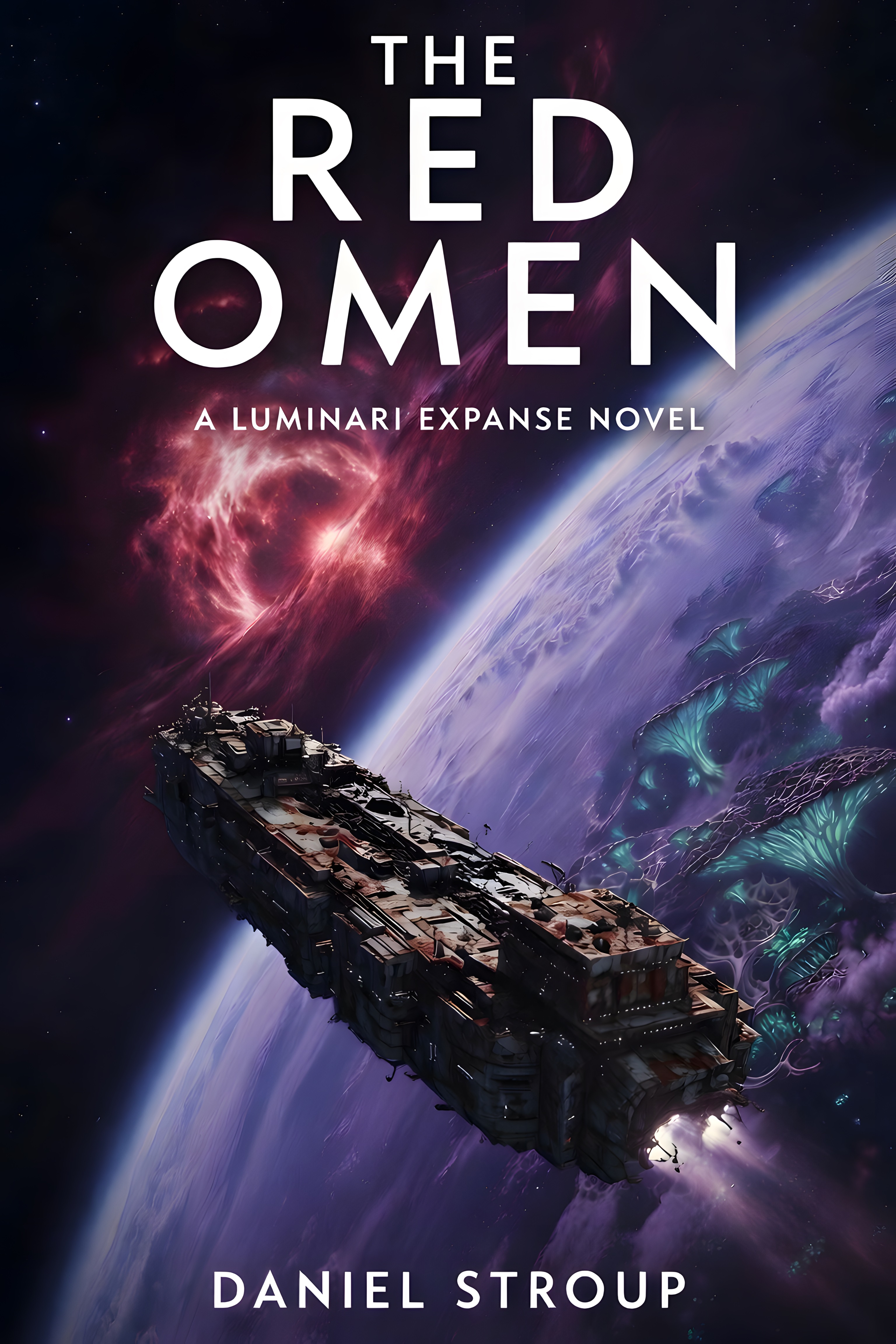
A published science fiction novella — taken from concept to print and Kindle, written with AI as an editing and prose partner, with zero prior publishing experience.
PublishedKindle + paperback
4.9★across 12 reviews
Amazoncommercially available
Goal vs. Delivery
The bar I setWhere I landed
Produce a complete, high-quality story genuinely worth reading — and finish itPublished novella, 119 pages, 12 chapters — finished and in print
A standard, not a number4.9★ across 12 reviews; readers and published authors asking for a sequel
The goal of this project — one of my earliest AI builds — was to prove I could carry a creative work all the way to a finished, quality product, not to hit a sales figure. Quality was the priority, and it was achieved. Sales were a secondary measure (a 12-copy expectation, 54 sold), and beating them reflects that the quality landed.

What Was Built

A complete science fiction novella, published on Amazon as both a Kindle ebook and a physical paperback — a full creative pipeline from concept through drafting, iterative editing, and commercial publication.

Why It Was Built

A long history of starting creative writing and abandoning it by page 2 or 3. The question: could AI break the roadblocks that stall creative projects and sustain enough momentum to reach a complete, polished result?

Starting Competence

Near-zero prior AI experience, no prior publishing, storytelling instincts but chronically stalled early. Strong planning and organization brought from elsewhere.

How AI Was Used

AI translated described scenes into vivid prose, creating the momentum prior attempts lacked. When full-chapter editing introduced story inconsistency, the fix was structure: a scene-by-scene outline plus a continuity document tracking every character detail. Every plot decision, character voice, and narrative call stayed human — AI was a language-elevation and consistency tool, not a co-author.

Timeline & Conditions

About ten months, worked in intensive bursts of inspiration with deliberate re-entry during low-energy stretches. No external deadline. AI-generated progress summaries made re-entry fast — the practice that kept a long project alive.

Outcome & Evidence

A complete, commercially available novella with a 1.5–2.5 hour read time. Reader response exceeded expectations, with consistent demand for a deeper sequel.

Key Metrics

Ebook + paperback (Amazon) · 119 pages, 12 chapters · 4.9★ across 12 reviews · published January 20, 2026 · ~10-month duration.

Lessons Learned

AI enables momentum, and momentum enables completion. Structure is what makes AI effective. Polish is iterative and never wasted. Re-entry into a paused project is a skill that can be systematized.

Forensic Financial Audit
A citation-backed forensic review of four years of chaotic bank records — built to inform an attorney's strategy, with no prior legal or financial-audit experience.
CITATION-BACKED MONEY-FLOW ANALYSIS
~15 hrsvs. weeks of manual work
Verifiedevery figure confirmed accurate
9 docs+ visual money-flow timeline
Scope: This audit was built to inform and guide the attorney's legal strategy. It is not court evidence and was never represented as such. Its job was to help counsel understand the financial picture and decide what to pursue — every claim traceable to a source document so the attorney could verify independently.

What Was Built

A forensic financial audit of civil-court discovery: four bank-account statement sets across four years, delivered deliberately chaotic — out of order, partially redacted, poorly re-scanned, pages rotated. Output: nine documents plus a visual money-flow timeline, every claim cited to file and page.

Why It Was Built

A civil case needed financial records analyzed to investigate suspected fiduciary mismanagement. Could AI-assisted analysis turn a multi-week forensic task into a structured, citation-backed audit — with no formal legal or financial training, and precision that isn't optional?

Starting Competence

No legal background, no financial-audit training, first substantive use of NotebookLM. Extensive prior Claude experience. Brought a discipline of traceable, sourced claims from prior documentation work.

How AI Was Used

Began with Claude, but context limits and poor scan quality made it the wrong tool — recognized and pivoted to NotebookLM for its larger context window and citation accuracy. Worked account by account, tracing money flow and classifying every transaction against records. The tool's raw reading of degraded scans was imperfect, so a continuous human audit layer verified every cited figure against the source before it entered any deliverable — every figure in the finished documents was confirmed accurate.

Timeline & Conditions

About 15 active hours across several days, after abandoned initial Claude attempts. Solo, no external deadline.

Outcome & Evidence

A complete audit package delivered to the attorney: per-file summaries with page citations, a master narrative, a visual money-flow timeline, and a structured questions document flagging anomalies and discrepancies for legal follow-up.

Key Metrics

NotebookLM + Claude · 4 accounts / 4 years · every cited figure human-verified against source · 9 documents + visual timeline · ~15 hours vs. a multi-week manual equivalent.

Lessons Learned

Match the tool to the task — context window is not optional. AI accuracy at scale still requires human verification: AI-then-audit, never AI-then-trust. A visual summary is as important as the citations underneath it.

Life Maintenance App
A cross-platform mobile app that tracks maintenance across everything you own — home, vehicles, boats, tools — designed and built with no prior software development experience.
~1 hrto a working prototype
iOS + Androidcross-platform
7-mindemo walkthrough
~1 hourFunctional prototype — concept to a working first version.
~20 hoursRefined, fully functional product — active work across 3 months.
A working prototype existed within an hour. Turning that into a refined, cloud-synced product took twenty hours of focused work over three months — the distinction between a quick demo and a finished product, made explicit.

What Was Built

A cross-platform (iOS + Android) maintenance-tracking app covering all asset types — home, vehicles, boats, power tools, landscaping equipment — with automatic task suggestions, service-record logging, receipt photos, and private cloud sync.

Why It Was Built

Existing apps force manual task entry and cover only one asset category. The goal: an all-in-one tracker that auto-suggests maintenance by asset type, stores records and receipts, and syncs securely while keeping data private.

Starting Competence

No formal software development background. Brought structured thinking and clear design intent to the AI collaboration.

How AI Was Used

A phased build with Claude and Replit: a structured requirements interview produced a full spec before any code; Claude turned the spec into a Replit build prompt (a functional MVP on the first attempt); a prompt-iterate-test loop refined it; Firebase added cloud sync and auth; Claude generated the change log, user agreement, and privacy policy.

Timeline & Conditions

Prototype in ~1 hour; refined product in ~20 active hours across 3 months, weekend sessions.

Outcome & Evidence

A fully functional cross-platform app: multi-asset tracking, auto-suggested timelines, receipt and cost logging, and Firebase cloud sync with a privacy-first model.

Key Metrics

Cross-platform mobile · Claude + Replit + Firebase · ~20 active hours over 3 months · working prototype in ~1 hour.

Lessons Learned

A deliberate, documented decision not to commercialize after a structured risk/cost/revenue analysis — the kind of risk-aware judgment that matters as much as the build itself. AI-assisted development demands the same discipline as any project: the technical build is only one layer; market, legal, and commercial viability deserve the same upfront rigor.

Multi-Agent Product Viability System
Eight AI agents that autonomously turn a product concept into an executive-ready business viability report — with quality control engineered into every step.
8 agents6 producers + orchestrator + QC
~3 hrszero to working system
$1.51to run a full analysis
A single execution run cost $1.51. The comparable boutique-consulting engagement for equivalent scope runs $15,000–$25,000 (2026 industry benchmarks). The system delivers that analytical depth in minutes rather than weeks.

What Was Built

An eight-agent AI system that takes a product concept as input and produces a comprehensive, executive-ready viability analysis. Six producer agents each own a discipline — market intelligence, customer analysis, go-to-market, financial modeling, risk assessment, and synthesis. A master orchestrator directs the overall arc, and a dedicated quality-control agent vets each producer's output before it passes to the next in sequence: producer → QC check → next producer, all under the orchestrator's direction. Built on CrewAI, powered by Claude via the Anthropic API, running locally on Python 3.12.

Why It Was Built

The purpose was a working capability, not a demonstration: a system that takes a product concept and autonomously produces a comprehensive viability report — competitive landscape, customer analysis, financial model, risk assessment — synthesized into a single recommendation. The standard it was built to meet was reliability: every output verifiable, every claim truthful, quality checked at each step before it moves forward.

Starting Competence

First time with CrewAI, direct API calls, and multi-agent orchestration; first time configuring a Python environment. Brought structured planning, precision questioning, and a standard for output that holds AI work to "would someone act on this?"

How AI Was Used

The build was real-time collaboration with Claude, from environment setup through agent design, the context-passing chain, and the quality-control architecture. Each agent received the accumulated context of all prior agents, letting the system reason across disciplines rather than within them — and the QC agent enforced a quality bar at each handoff so flaws couldn't propagate downstream. The first-generation output was then critiqued against an executive standard: eight specific quality problems identified, translated into an ordered rebuild specification, and the improved system verified functional.

Timeline & Conditions

About 3 hours, single session, zero to working system. Total API cost $1.51. Rebuild executed and verified in a follow-on session.

Outcome & Evidence

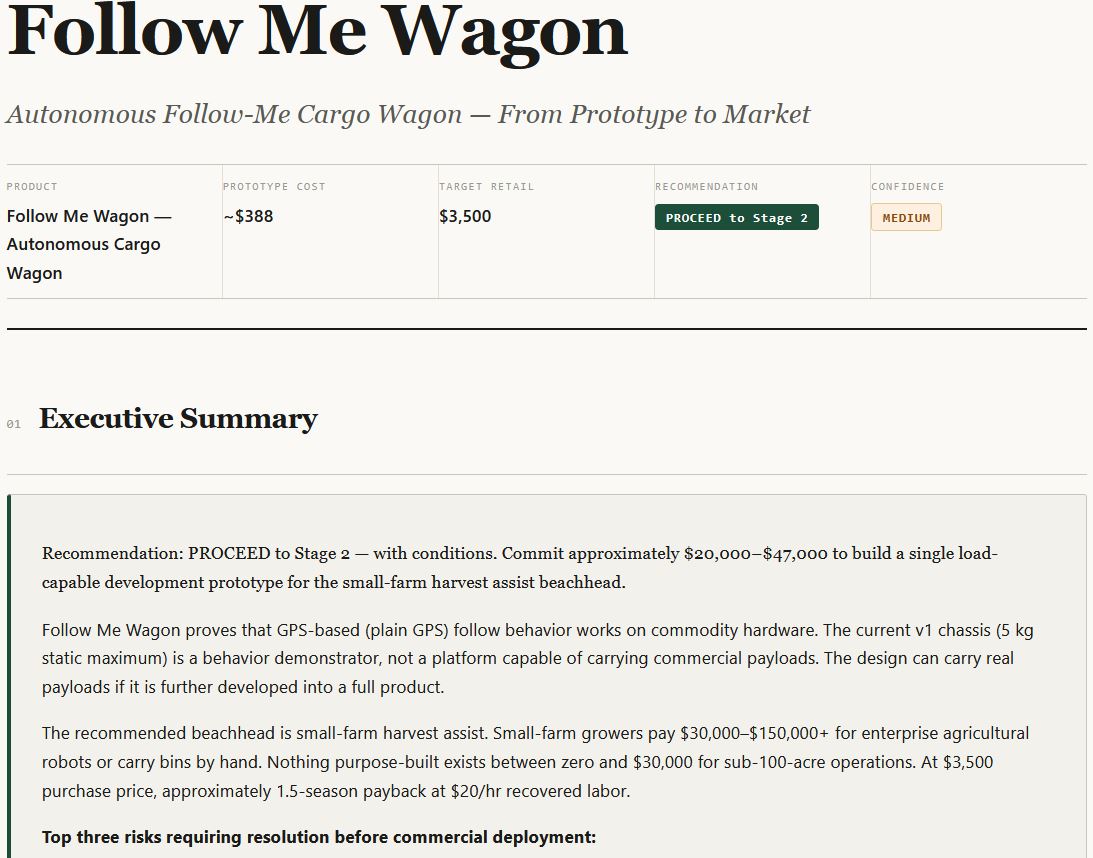
A functional pipeline producing a unified viability report from six discipline analyses, converted into a polished, self-contained HTML executive deliverable — complete with bill of materials and V2 roadmap. The interim proof artifact is that HTML report: the FollowMeWagon viability analysis the system produced.

Key Metrics

8 agents (6 producers + orchestrator + quality control) · ~3-hour build · $1.51 run cost · $15–25K consulting equivalent · Claude via Anthropic API · CrewAI / Python 3.12.

Lessons Learned

Multi-agent architecture multiplies output quality if designed right — the architecture is the leverage, and quality control belongs inside the process, not bolted on after. Build time isn't the measure; output quality is — "would a CTO act on this?" is the standard. AI slop is a choice: every first-pass flaw was predictable, and the professional failure mode is accepting flawed output because it looks finished.

luminariexpanse.com
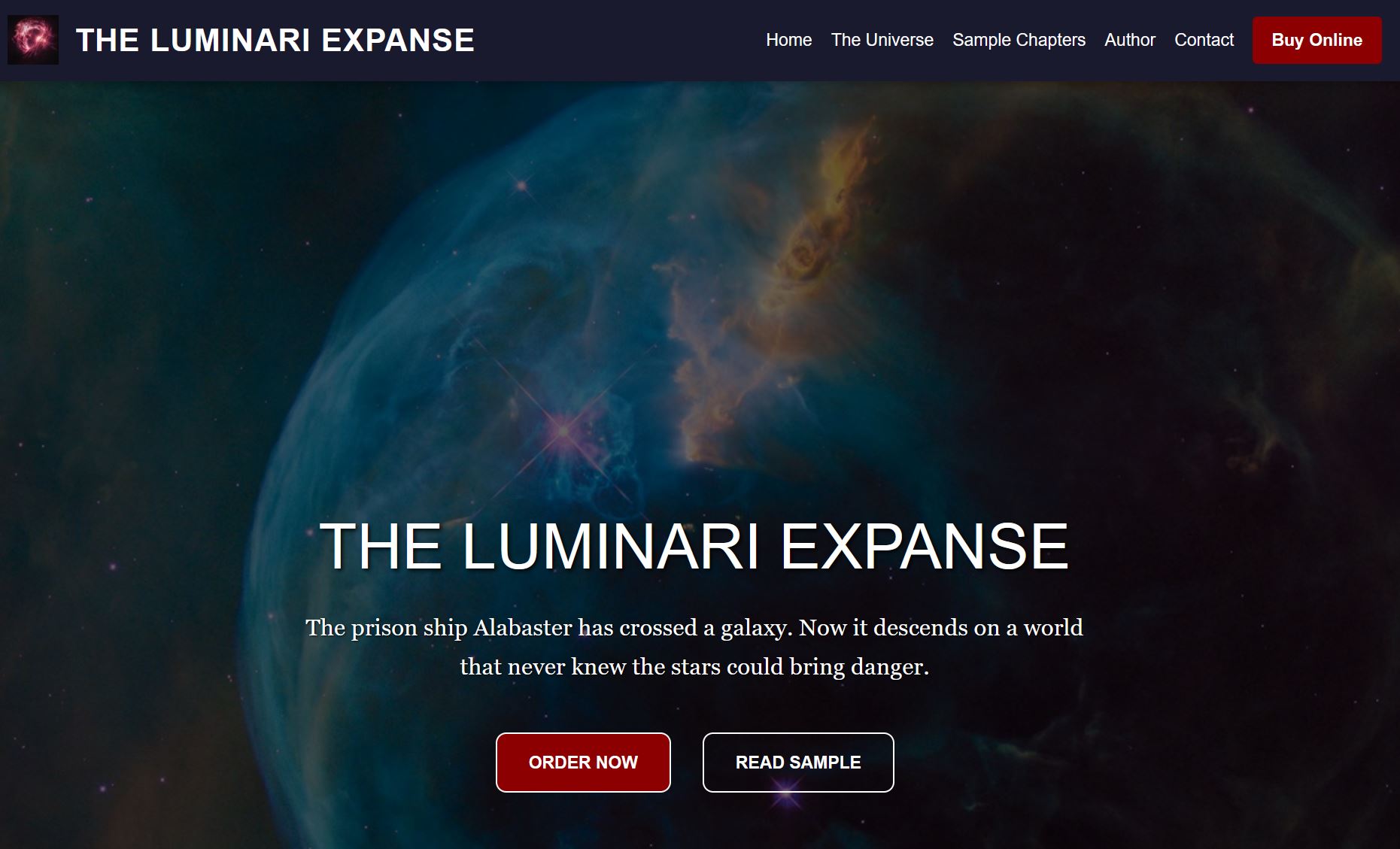
A live, custom-coded author website built from scratch in WordPress — first website ever built, with zero prior coding or web-development experience.
5 pageslive and functional
0prior web-dev experience
Livesite in production
Goal vs. Delivery
The bar I setWhere I landed
A live, multi-page author site, built without a developer or a template5 pages live, custom HTML in WordPress, solo
~7–10 days (estimate)Launched inside that window

What Was Built

The official site for The Luminary Expanse science fiction series: five live pages, built entirely with custom HTML implemented in WordPress. The first website ever built, with no prior coding.

Why It Was Built

A published author needs a presence beyond an Amazon listing — a professional home for readers to explore the world, preview the work, and make contact, architected to grow as the catalog does. Built from scratch with AI rather than a hired developer or a limiting template.

Starting Competence

Template-only prior experience, effectively zero coding, no WordPress or HTML. Brought clear design intent and the ability to describe desired outcomes precisely.

How AI Was Used

Claude evaluated hosting options (WordPress selected), then generated complete HTML page by page with implementation instructions. The real work was troubleshooting: Claude's instructions were calibrated to an older WordPress UI, causing rendering issues resolved through iterative back-and-forth. A key discovery — that JavaScript features required a higher paid tier — became a deliberate scoping decision to redesign rather than upgrade.

Timeline & Conditions

7–10 days total, including 2+ days for DNS propagation. A side project, self-directed, no external deadline.

Outcome & Evidence

A fully functional live author website, all five pages working, built by a first-time web developer with AI-generated HTML.

Key Metrics

WordPress · Claude-generated HTML · 5 pages · Grok for concept art · no prior web-dev or coding · 7–10 days · solo · live.

Lessons Learned

AI as a real-time expert guide beats any generic tutorial. Version drift is real — verify AI's platform instructions against the live interface. The right input method changes everything. Constraints are decisions, not failures.

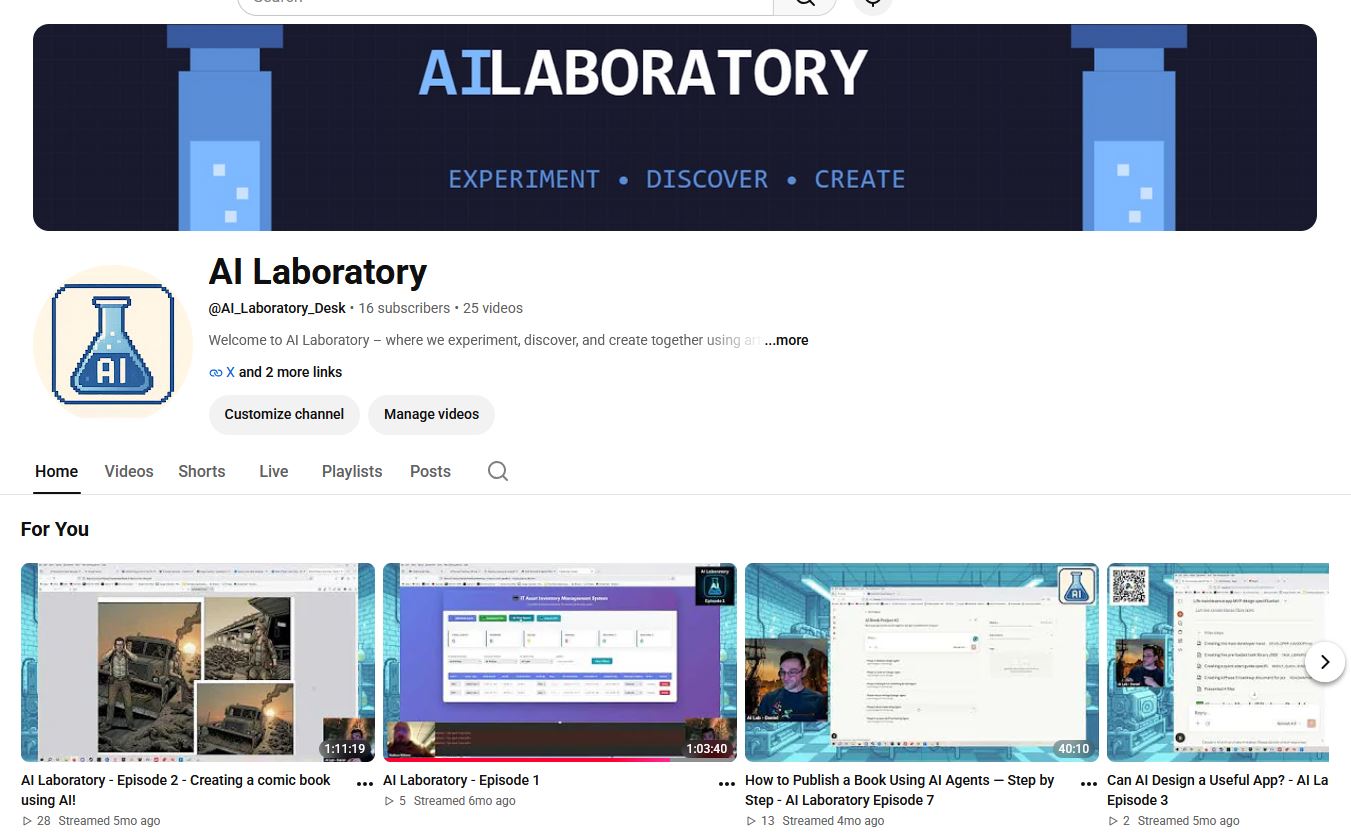
AI Laboratory Podcast
A live, multi-platform video podcast solving real problems with AI in real time — produced with an automated workflow that cut post-production effort by ~80%.
7 episodesproduced over ~2 months
3 platformsstreamed simultaneously
~80%less post-production effort

What Was Built

A live-streamed video podcast broadcast simultaneously to YouTube, X, and Twitch — seven ~1-hour episodes over about two months. Both a platform for solving real problems with AI and an AI experiment in its own right, built around automation to kill the post-production burden that ends most podcasts.

Why It Was Built

Two problems: prior podcast attempts demanded 2–12 hours of post-production per episode (a motivation-killer), and AI experimentation stays shallow without a forcing function. The show solved both — automated production for sustainability, and a live cadence to force a real experiment every episode.

Starting Competence

Prior podcast experience, but only manual, labor-heavy workflows; multi-platform streaming was new; early-stage AI fluency. Brought organizational instincts and structured workflow design.

How AI Was Used

An extended Claude session designed the show before recording — audience, format, structure, workflow — and evaluated automation tools. Yardstream enabled simultaneous streaming, recording, and clip generation; Opus added short-form clips. Claude generated episode ideas, outlines, and hooks. Each episode ran a live AI experiment — some succeeded, some (a fantasy-sports chatbot) hit scope limits — and several became standalone portfolio projects.

Timeline & Conditions

7 episodes over ~2 months, ~1 hour each, self-directed. Concluded due to an insufficient guest pipeline — not a workflow failure.

Outcome & Evidence

Proved a fully automated, multi-platform production workflow is achievable with first-generation AI tools, with time savings large enough to make consistent production viable. Several on-air experiments seeded other portfolio projects.

Key Metrics

7 episodes · YouTube / X / Twitch simultaneous · 2–12 hr → 1–2 hr post-production (~80% reduction) · Yardstream + Opus · ~2-month duration.

Lessons Learned

Design the architecture before you build. Automation solves the production problem, not the motivation problem — a collaboration-dependent format needs guests secured up front. Failure is valid data. Side projects compound.

Creating a Digital Comic Book with AI
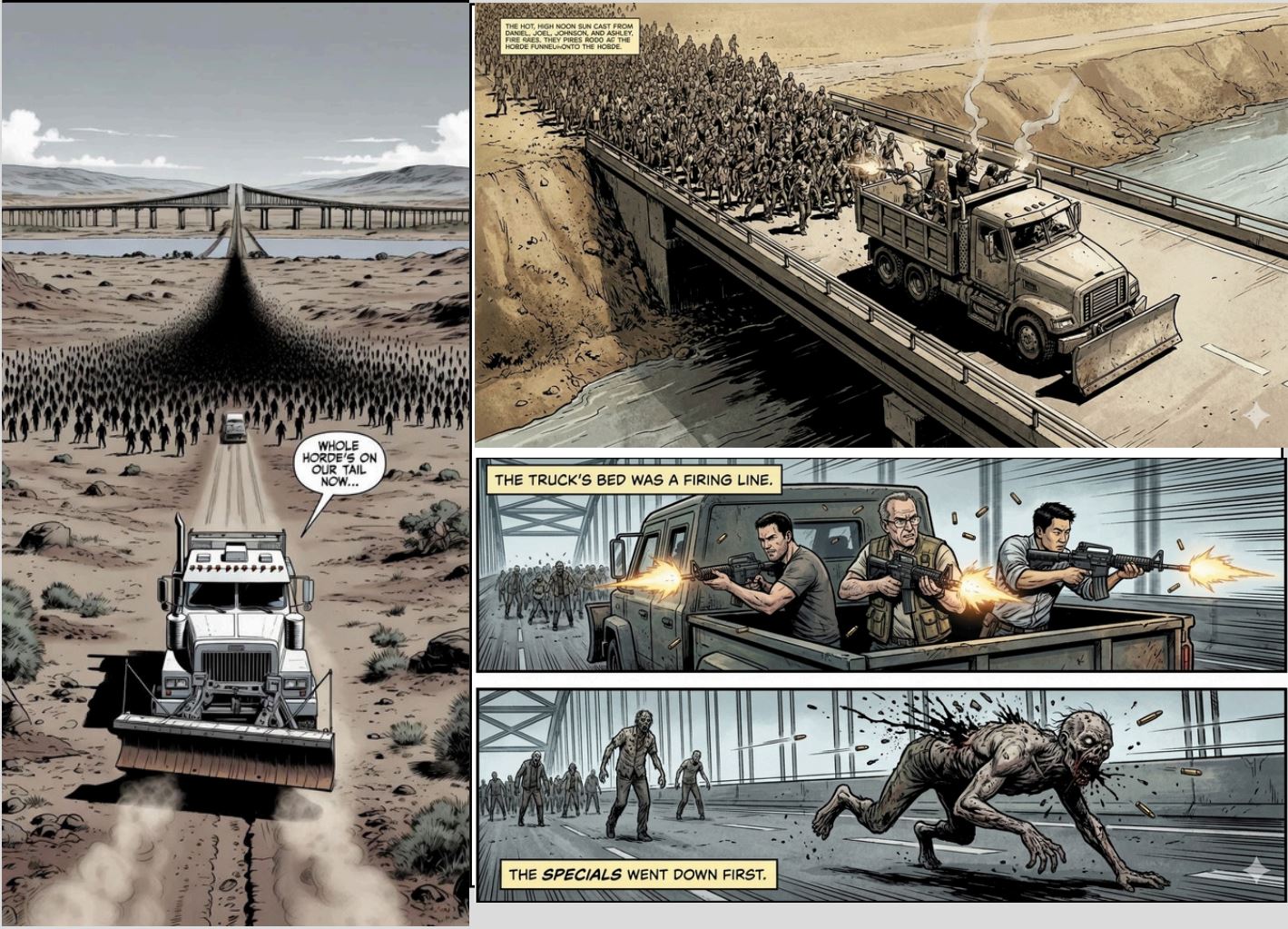
A controlled head-to-head test of six AI image platforms — same prompt, same characters — producing a 4-page comic in 70 minutes, and an honest finding about where these tools still fail.
6 platformstested head-to-head
~70 minfirst prompt to finished comic
Findingconsistency failed across all

What Was Built

A 4-page zombie-apocalypse comic produced as a live podcast demo, using one master prompt across six AI image platforms (Grok, ChatGPT, Claude, Gemini, Leonardo.ai, and one more) to compare them head-to-head.

Why It Was Built

A practical question for anyone weighing AI image generation as a production tool: which platforms are genuinely useful, and where do they fail, given identical prompts, character references, and genre requirements?

Starting Competence

Limited prior AI image-generation experience, no comic-production experience. Brought prompt design, a controlled-comparison methodology, and the ability to evaluate outputs against clear criteria.

How AI Was Used

A single master prompt — character descriptions, reference photos, setting, art-style parameters — was submitted identically to all six platforms, a controlled comparison holding input constant and varying only the platform. Grok produced the highest volume fastest on free tier (most final panels); ChatGPT had the best per-image quality; others hit free-tier limits quickly.

Timeline & Conditions

About 70 minutes, first prompt to a finished 4-page comic, live on the podcast, free-tier accounts throughout.

Outcome & Evidence

A complete 4-page comic in 70 minutes — impossible before these tools. But the artwork shows the limitation honestly: art style is inconsistent across panels and character likeness is not maintained frame to frame. A demonstration piece and honest MVP, not a commercially publishable product.

Key Metrics

6 platforms · ~70-min build · Grok best volume/speed · ChatGPT best quality · character consistency: none achieved across any platform · free-tier limits hit by several.

Lessons Learned

Speed is genuinely impressive; consistency is not. Free-tier limits are a real constraint in any honest platform comparison. Photo references did not guarantee likeness — a known, evolving limitation worth revisiting with newer models. A structured comparison methodology — constant input, one variable — produces usable findings.

About

Daniel Stroup

I've made a habit of starting over in unfamiliar territory. I went from firefighter to pilot — two fields with steep learning curves and no room for getting it wrong — driven by the same thing each time: a perpetual curiosity and a refusal to let not knowing how stop me from figuring it out.

I'm a builder by nature. What I care about most is taking an idea from concept to something real — and AI has become the most powerful tool I've ever found for closing that gap. It lets me move from "I wish this existed" to a finished, working result faster than I ever could alone, across domains I'd never touched before.

That's what every project on this page has in common. None of them were in my wheelhouse when I started. A published novel, an autonomous robot, a forensic financial audit, a multi-agent AI system — each one began with no prior experience and a clear intention to see it through. The approach is always the same: think hard before building, scope it deliberately, use AI as an expert guide, verify everything, and finish.

Underneath all of it is a simple motivation — I want to make the world a little better, and I've found that AI is remarkably good at turning an idea meant to do that into something that actually exists.

Contact

Let's build something

Available for AI consulting. If you or your company has a problem worth solving with AI, I'd like to hear about it.